Best Stroller for Dogs: 5 Picks and a Practical Buying Guide
We may earn a commission for purchases made using our links. Please see our disclosure for more details.
A long walk can become difficult when your dog tires quickly, struggles with stiff joints, or simply cannot keep up. Carrying them home is not always realistic, especially when they weigh more than a few pounds. A stroller for dogs can offer a place to rest while still allowing your companion to join suitable outings.
But choosing one involves more than finding a cute design. A stroller that feels roomy in photos might have a narrow cabin, awkward entrance, or wheels that struggle with your usual route. Some models are convenient on sidewalks; others are built for trails or larger dogs. This guide compares five useful options and explains how to check fit, safety, comfort, and everyday practicality before buying.
When Does a Dog Actually Need a Stroller?
A stroller makes sense when a dog enjoys outings but cannot comfortably manage the entire distance. Common situations include older dogs with reduced stamina, small dogs on long family trips, or pets recovering under a veterinarian’s activity restrictions.
It can also provide a controlled resting space in busy settings, provided your dog tolerates the environment. However, unexplained limping, weakness, or sudden fatigue deserves a veterinary assessment rather than an immediate equipment purchase. A stroller is transportation, not treatment.
Three-Wheel, Four-Wheel, and Wagon-Style Designs
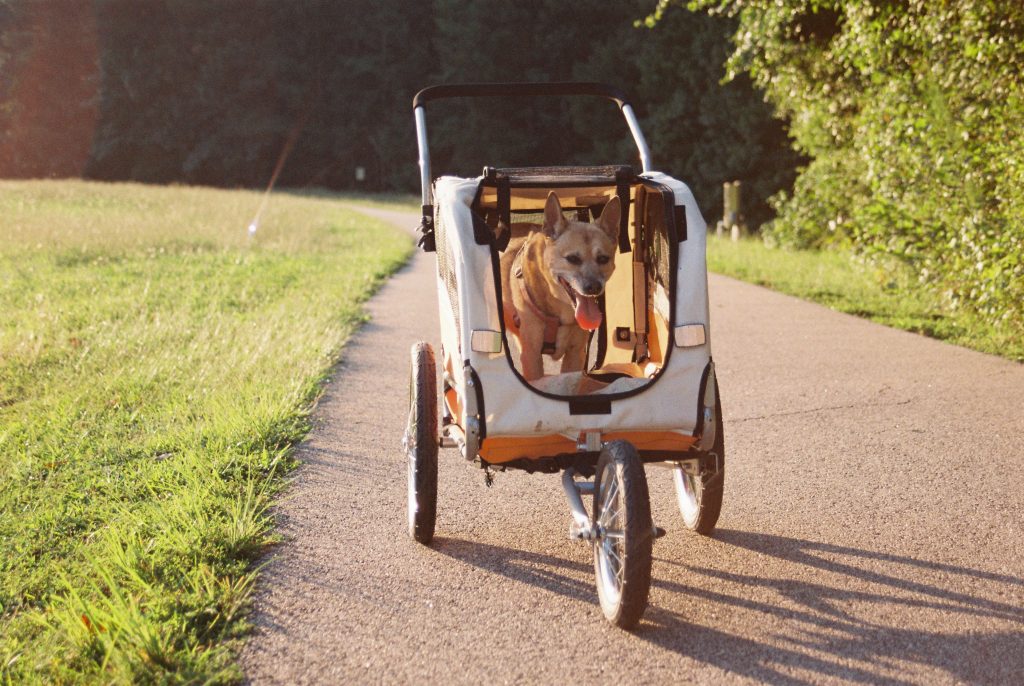
Three-wheel models can steer smoothly around corners, particularly with a swiveling front wheel. Larger jogging-oriented versions often let you lock that wheel for straighter movement.
Four-wheel designs suit many paved routes and may offer a familiar upright layout. Wagon-style strollers place larger dogs closer to the ground, making entry easier, but generally need more storage space.
Do not judge stability by wheel count alone. Wheelbase, load placement, brakes, and the dog’s movement inside all affect handling.
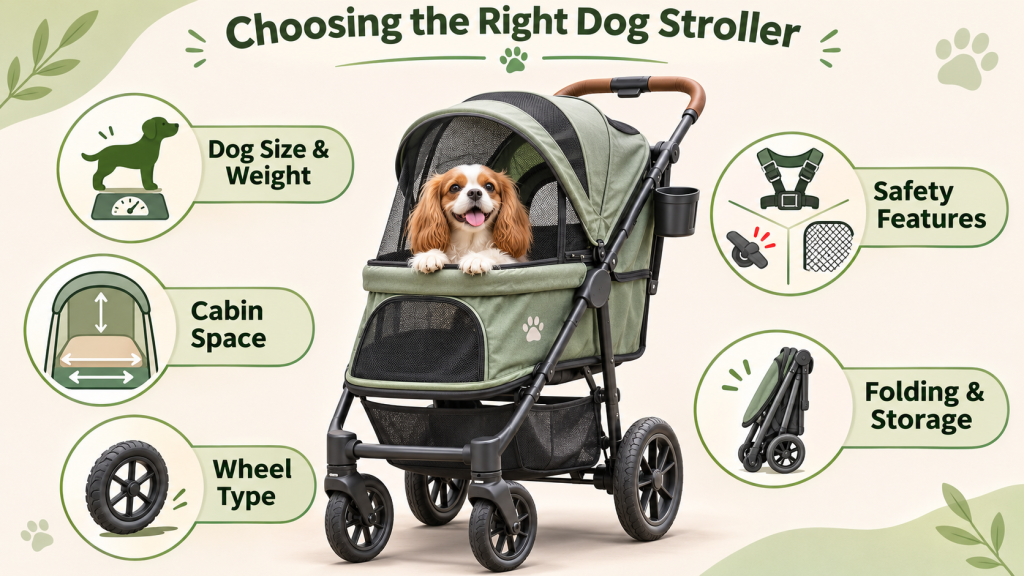
Measure Your Dog Before Comparing Strollers
Start with your dog’s length while lying naturally, width across the body, and height when sitting comfortably. Compare these measurements with the actual interior space available, rather than the stroller’s overall dimensions.
Your dog should be able to settle, change position, and turn without being squeezed against the walls. Also measure the entrance: a generously sized cabin does little good if a stiff or injured dog cannot get through the opening.
If you plan to carry two small dogs together, measure the space they need side by side rather than assuming their combined weight tells the whole story.
Check Weight Capacity and Cabin Space Together
A stated load limit describes how much weight a stroller is designed to carry; it does not guarantee a comfortable fit. A long-bodied dog can outgrow a cabin while remaining below its maximum load.
Leave room for the manufacturer’s allowed bedding and accessories, and never exceed stated limits. Check whether storage-basket capacity is listed separately from the pet compartment.
For puppies still growing, consider expected adult size. For dogs with limited mobility, prioritize a stable floor and an entry that avoids unnecessary lifting or twisting.
Choose Wheels for Your Actual Walking Route
Small wheels are practical on smooth pavement, indoor floors, and short errands. They can catch on cracks and become difficult to push across gravel or uneven paths.
Larger wheels and suspension are more useful on rough sidewalks, packed trails, and grass. A locking front wheel can help on straight stretches, while swivel steering is easier in tight spaces.
Think about the entire trip, including curb ramps and your building entrance. A stroller described as all-terrain is not automatically suitable for sand, steep slopes, or every jogging pace.
Safety Features Worth Prioritizing
Look for dependable parking brakes, an enclosure that closes securely, breathable mesh panels, and an internal tether compatible with a properly fitted harness. A collar attachment can put pressure on the neck if the dog suddenly jumps.
Test the brake before every outing, especially on a slope, and never leave your dog unattended inside. Keep the tether short enough to prevent escape but loose enough for normal resting positions.
Reflective details help visibility after dark, but they do not replace lights, supervision, or choosing a sensible route. Follow the stroller’s own instructions for restraints and wheel locks.
Recommended Stroller for Dogs: Five Options Compared
These models serve different routines. Their features and capacities should be checked against the exact variation available before purchase, especially when a brand offers several similar versions.
MoNiBloom 3-Wheels Foldable Pet Stroller
Best for: Budget-conscious owners of small dogs
This folding stroller has mesh ventilation, front and rear zippered access, a storage basket, and a 33-pound stated capacity. Its compact three-wheel layout works best for paved walks and occasional errands. The smaller wheels are less appealing for uneven trails, and a larger dog may find its interior too narrow despite meeting the weight limit.
Pet Gear No-Zip NV Pet Stroller (New Rose)
Best for: Regular walks with extra comfort features
The NV combines push-button, zipperless access with a panoramic window, plush pad, and gel-filled wheels. A front wheel lock and rear brakes make it more adaptable than basic sidewalk models. Its approximately 32-pound stroller weight is a substantial drawback if you frequently lift it into a car or carry it upstairs.
HPZ Pet Rover Premium Heavy Duty Pet Stroller (Midnight)
Best for: Owners wanting an adjustable, roomy layout
The Pet Rover Premium has an expandable compartment, reversible handlebar, mesh canopy, and washable pads. These features help when traveling with different-sized pets or choosing which direction your dog faces. Its comparatively broad frame can feel cumbersome in narrow doorways, so check both the open dimensions and folded storage space before committing.
ibiyaya The Beast Pet Jogging Stroller
Best for: Packed trails and active walking routes
The Beast uses a reinforced aluminum frame, large maintenance-free wheels, suspension, and two braking controls. Its 55-pound pet limit suits some medium dogs, while the front and rear openings simplify loading. The trade-off is bulk: the wide frame and larger folded dimensions make it less practical for compact cars or cramped hallways.
Pet Gear No-Zip Expedition Pet Stroller (New Fog)
Best for: Large dogs needing easier entry
The Expedition provides a spacious, lower-positioned compartment with front and rear push-button entrances, two interior tethers, and an adjustable handle. Dogs that cannot comfortably turn around inside a smaller stroller may appreciate the walk-through design. This is a sizable piece of equipment, so measure your doors and trunk before buying, even if its stated load rating suits your dog.
Match the Stroller to Your Daily Routine
For short neighborhood outings with a small dog, a simple folding model may cover everything you need. Frequent longer walks can justify better wheels, an easy-opening canopy, and a washable pad.
If your dog has trouble stepping up, prioritize a low entrance over cup holders or styling.
Keep Your Dog Comfortable in Different Weather
Mesh panels allow airflow and help you monitor your dog, but an enclosed stroller can still become dangerously warm. Avoid hot conditions, direct sun, and weather covers that restrict ventilation. Being in the shade does not eliminate the risks of extreme heat.
Choose a padded, stable base that does not slide when turning. A removable liner helps with occasional accidents and muddy paws.
Check the dog’s behavior regularly. Persistent panting, agitation, or attempts to escape suggest the trip needs to stop. Offer water and appropriate breaks; do not treat the canopy as climate control.
Folding, Transport, and Storage Matter More Than Expected
Before ordering, compare folded dimensions with your trunk, closet, elevator, and doorway. A one-hand folding claim is convenient, but the release mechanism and overall lifting weight still matter.
Check whether wheels must be removed to fit the stroller in your car and whether the folded frame locks securely.
Practice unfolding and locking the frame without your dog nearby. Never place a pet inside until the stroller is fully open and stable.
Help Your Dog Accept the Stroller Gradually
Park the stroller indoors with its brakes engaged and let your dog investigate at their own pace. Offer treats near the entrance, then inside once they seem relaxed. Do not force a frightened dog into the compartment.
When your dog is calm, secure their harness to the approved tether and try a brief, slow movement on level ground. Reward relaxed behavior and end the session before distress builds.
Build toward short outdoor walks. Dogs that cannot safely step in should be lifted or assisted only in ways permitted by their veterinarian.
Cleaning and Maintaining a Pet Stroller
Brush away dirt and hair after outings, then clean the liner according to its care label.
Inspect tire surfaces, wheel attachments, brake action, canopy closures, and tether stitching regularly. Grit around a swivel wheel can make steering harder, while a worn latch may compromise containment.
Avoid improvising structural repairs or adding heavy bags to the handle, which can change balance. Ask the manufacturer for compatible replacement parts when something breaks.
What Veterinary Research Says About Heat and Mobility
A stroller can reduce the distance a dog needs to walk, but research does not establish that stroller use itself treats arthritis, prevents injury, or eliminates heat-related illness.
A 2022 VetCompass study of severe and fatal heat-related illness in UK dogs found that older dogs and short-nosed breeds faced important risks of serious or fatal outcomes. The researchers examined veterinary records, not stroller temperatures, so their findings should not be taken as proof that any stroller protects dogs from heat.
The practical lesson is to choose cool conditions, maintain ventilation, watch for distress, and consult your veterinarian about exercise limits. For more ideas on supporting reduced mobility around the home, explore these elder pet care tips.
Frequently Asked Questions About Dog Strollers
Can senior dogs benefit from using a dog stroller?
They can be helpful when an older dog enjoys going outside but cannot manage the full walk. Choose a model with easy access and a comfortable resting surface. Ask your veterinarian about appropriate activity, especially if arthritis, heart disease, or weakness is involved. Healthy movement should not disappear simply because a stroller is available.
Is it safe to place two dogs in the same stroller?
Yes, if the manufacturer permits multiple pets and both dogs fit comfortably within the stated load limit. Check usable floor space, entry size, and available tether points for each dog. Some dogs become restless sharing a confined cabin, so try a short stationary session first and do not force them to ride together.
Can a dog stroller be used for jogging?
Only if the manufacturer explicitly supports jogging for that specific model and your planned surface. Look for appropriate tires, steering controls, and stable handling. Secure your dog before moving, begin slowly, and avoid rough terrain that causes excessive bouncing. A model described as three-wheel is not automatically safe for running.
Can a stroller replace my dog’s daily walk?
Usually not. Riding provides a change of scenery but does not supply the same physical activity as walking. Many dogs still benefit from suitable movement, sniffing, and bathroom breaks. The right balance depends on age, health, and veterinary advice. Treat the stroller as an option for resting or longer outings, not a substitute for needed exercise.
Is a dog stroller suitable for car travel?
A regular pet stroller should not be treated as a crash-tested vehicle restraint. Its cabin or detachable carrier is suitable for car use only when the manufacturer explicitly specifies the intended installation and safety provisions. For driving, choose a properly secured travel restraint designed for vehicle use rather than relying on stroller straps or a folded frame.
Conclusion: Choosing the Right Stroller for Dogs
The right stroller depends first on your dog’s body and abilities, then on where you actually walk. Check interior measurements alongside the weight limit, choose wheels that fit your route, and insist on functioning brakes, ventilation, and secure harness attachment.
For occasional paved outings with a small dog, the MoNiBloom may be enough. The Pet Gear No-Zip NV brings more comfort features for regular use, while the Expedition is worth considering when a large dog needs a spacious, easier entrance. No premium feature can make up for poor fit or a ride your dog dislikes.
Choose a stroller for dogs that your companion can rest in comfortably and that you can safely handle, fold, and store every time you go out.