Dog Training Whistle Tips for New Dog Owners

We may earn a commission for purchases made using our links. Please see our disclosure for more details.
You know that tiny panic moment when your dog spots a squirrel, turns into a furry rocket, and suddenly “come here” means absolutely nothing? Yep. That is where a dog training whistle can become your quiet little superhero.
A whistle will not magically turn your dog into a perfectly behaved angel overnight. Dogs are wonderful, but they are not Wi-Fi devices. You still need patience, practice, and rewards. But when used correctly, a whistle can give your dog a clear, consistent cue that cuts through noise, distance, and your slightly stressed “PLEASE come back” voice.
Some product mentions below are for Amazon items and may be used for affiliate-style product recommendations.
What Is a Dog Training Whistle?
A dog training whistle is a small training tool that creates a sharp, consistent sound your dog can learn to recognize.
Some whistles make sounds humans can hear. Others are called “silent” or ultrasonic whistles, although they are not truly silent. They simply produce a pitch that dogs hear better than humans.
According to the American Kennel Club, dogs can hear higher-pitched sounds than people, which is why whistles can work well as long-distance training cues. However, the whistle itself does not tell your dog what to do. You must teach the meaning behind the sound.
Think of it like a doorbell. The sound only means “someone is here” because you learned that pattern. Your dog needs that same kind of learning.
Why Dog Whistle Training Works
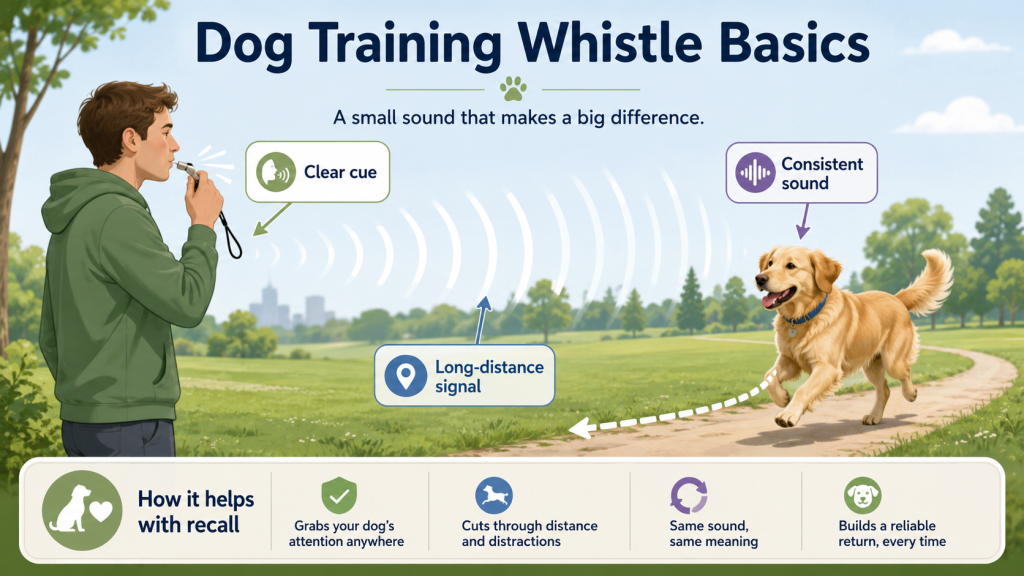
Dog whistle training works because it gives your dog a signal that stays the same every time.
Your voice changes constantly. You may sound cheerful at home, rushed at the park, or slightly betrayed when your dog rolls in something questionable. A whistle does not have that emotional wobble.
A whistle can help with:
- Recall training for dogs
- Distance commands
- Off-leash practice
- Field training
- Puppy obedience
- Multi-person households
This makes it especially useful when different family members train the same dog. Whether you, your partner, or your teen uses the whistle, the cue sounds more consistent than five different versions of “come.”
Dog Training Whistle vs Voice Commands
Voice commands are still useful. Please do not throw your “sit” and “stay” out the window.
A whistle simply adds another layer.
Voice commands are best for:
- Close-range training
- Daily home routines
- Emotional bonding
- Simple obedience cues
Whistle cues are best for:
- Recall across distance
- Outdoor distractions
- Clear repeated signals
- Dogs who ignore shouting
The sweet spot? Use both. Your voice builds connection. The whistle adds clarity.

When Should You Start Using a Dog Training Whistle?
You can start whistle training once your dog is comfortable taking treats, paying attention, and learning simple cues.
For puppies, short sessions work best. Their attention span is basically “snack, leaf, sock, nap.” Keep it light.
For adult dogs, you can start anytime. Even older dogs can learn a whistle cue if their hearing allows it. Just move slowly and make the reward worth their effort.
How to Choose the Right Dog Whistle
Choosing the right whistle does not need to feel like picking a spaceship part.
Look for a whistle that is:
- Comfortable to hold
- Easy to blow
- Consistent in sound
- Durable enough for walks
- Suitable for your dog’s size and sensitivity
Fixed-pitch vs adjustable whistles
A fixed-pitch whistle gives the same sound every time. This is great for beginners because consistency matters.
An adjustable dog whistle lets you change the frequency. That can be useful, but it can also create confusion if you keep changing it.
Audible vs silent dog whistle
An audible whistle lets you hear what you are doing. This helps you keep your whistle commands consistent.
A silent dog whistle can be helpful if you live close to neighbors, but beginners may find it harder to know whether they blew the cue clearly.
How to Introduce the Whistle Without Scaring Your Dog
Start indoors where life is boring. Boring is your friend during training.
Blow the whistle softly once. Give your dog a valuable treat right away. Do not ask for anything yet. You are simply teaching, “This sound means good things.”
Repeat this 5–10 times.
Then stop.
That is enough for the first session. You want your dog thinking, “Wait, where did the magic snack sound go?”
Step-by-Step Whistle Recall Training
Recall is the most popular reason people use a dog training whistle.
Here is a simple beginner method.
Step 1: Pair the whistle with rewards
Blow the whistle once or use your chosen pattern. Give a treat right away.
Do this several times over a few days.
Step 2: Add movement
When your dog is a few feet away, blow the whistle. When they look at you or move toward you, praise warmly and reward.
Step 3: Increase distance slowly
Move from the living room to the hallway. Then the yard. Then a quiet outdoor space.
Do not jump from “kitchen practice” to “busy dog park chaos.” That is like learning one piano song and immediately joining a jazz band.
Step 4: Add distractions
Practice around mild distractions first, such as toys, family members, or low-level outdoor noise.
Step 5: Reward every successful recall
In the beginning, pay your dog like they just won employee of the month.
Use chicken, cheese, training treats, or a favorite toy.
Basic Dog Whistle Commands You Can Teach
A whistle can be used for more than recall, but keep things simple at first.
Common dog whistle commands include:
- One short blast: look at me
- Two or three short blasts: come back
- One long blast: sit or stop
- Repeated short blasts: emergency recall
Pick your patterns and stick to them. Do not freestyle like a jazz musician unless your dog has also studied jazz.
Common Dog Whistle Mistakes to Avoid
Most whistle training problems come from rushing.
Avoid these common mistakes:
- Blowing the whistle when your dog is already ignoring you
- Using it too often without rewards
- Changing the whistle pattern randomly
- Training in distracting places too soon
- Using the whistle as punishment
- Expecting instant results
A whistle should feel like good news to your dog, not like a tiny referee yelling at them.
Best Dog Training Whistle Products
Here are five relevant Amazon dog whistle options that fit different training needs. Product availability and details can change, so always check the current listing before buying.
SportDOG Roy Gonia Special Whistle
The SportDOG Roy Gonia Special Whistle is a classic field-training option designed for long-range projection and everyday training. Amazon lists it as a durable plastic whistle with an easy-to-blow design.
Features:
- Long-range sound
- Durable plastic body
- Popular for hunting and field training
- Simple design for beginners
Best for: New dog owners who want a reliable, no-fuss whistle for recall practice.
SportDOG Brand Competition Mega Whistle
The SportDOG Brand Competition Mega Whistle is designed for strong projection and field use. It is a good pick for outdoor spaces where wind, distance, and noise can compete with your cue.
Features:
- Loud carrying sound
- Easy-to-blow design
- Built for outdoor training
- Handler-friendly shape
Best for: Active owners, sporting dogs, and dogs who train in open areas.
ACME Original “Silent” Dog Training Whistle No. 535
The ACME Original “Silent” Dog Training Whistle No. 535 is an adjustable-frequency whistle made with a solid brass design. Amazon describes it as weather-proof and adjustable.
Features:
- Adjustable frequency
- Solid brass build
- Weather-proof design
- Less noticeable to people nearby
Best for: Owners who want a quieter whistle option for neighborhood training.
Browning Dog Training Whistle
The Browning Dog Training Whistle is a hunting-style whistle designed without a pea, which helps prevent rattling. Amazon also notes that it includes lanyard options.
Features:
- Pealess design
- Durable plastic
- Includes lanyard options
- Built for outdoor use
Best for: Outdoor dog owners who want a simple training whistle with practical carry features.
ACME Alpha 211.5 Professional Dog Training Whistle
The ACME Alpha 211.5 Professional Dog Training Whistle is listed on Amazon as a professional whistle with an ergonomic grip, standardized frequency, weatherproof design, and BPA-free plastic construction.
Features:
- Ergonomic grip
- Standardized frequency
- Weatherproof body
- Good for structured recall training
Best for: Owners who want a more polished fixed-frequency whistle for consistent dog obedience training.
What Research Says About Whistle Training and Positive Reinforcement
A dog training whistle works best when it becomes a happy, predictable cue. The whistle itself does not teach your dog anything. The reward after the whistle is what gives it meaning. That matches the American Kennel Club’s guidance that whistles are simply training cues, not magic commands, and dogs must learn what each whistle pattern means through practice and rewards. Use this as a source with the anchor text: whistle cues work best when paired with rewards.
Research also supports using reward-based methods instead of fear-based corrections. A 2020 PLOS ONE study found that dogs trained with aversive-heavy methods showed more stress-related behaviors than dogs trained with reward-based methods. This is important because your whistle should feel like good news to your dog, not a warning siren. Use this source with the anchor text: reward-based dog training protects your dog’s emotional well-being.
Positive Reinforcement Makes the Whistle Meaningful
Your dog does not care about the whistle at first.
They care about what happens after it.
If the whistle predicts roast chicken, praise, play, or freedom, your dog starts listening. If it predicts frustration, leash jerks, or the end of fun every single time, your dog may avoid it.
Try this:
- Blow whistle
- Dog comes
- Reward generously
- Release your dog to play again sometimes
That last part is powerful. If coming back does not always mean “fun is over,” your dog will trust the cue more.
Safety Tips for Dog Whistle Training
Use the whistle kindly and carefully.
Do not blow it right beside your dog’s ears. Do not use it repeatedly at high intensity. And please do not use ultrasonic sounds to annoy a barking dog into silence.
Also, check your environment. If you are training in a yard, make sure it is secure. If you are practicing near plants, patios, or garden areas, it is smart to create a safe space with pet-safe house plants and dog-friendly greenery, especially if your dog loves sniffing everything like a tiny detective.
Troubleshooting: Why Your Dog Ignores the Whistle
If your dog ignores the whistle, do not panic. It usually means one of three things.
The whistle has no meaning yet
Go back to pairing the sound with treats.
The distraction is too strong
Practice somewhere easier before trying the park.
The reward is too boring
Dry kibble may not beat a squirrel. Upgrade the paycheck.
Training is not about being louder. It is about being clearer and more rewarding.
Dog Whistle Training for Different Types of Dogs
Every dog brings their own personality.
A confident Labrador may charge back joyfully. A nervous rescue dog may need slower, softer practice. A tiny dog may react differently to certain pitches than a large working breed.
Be flexible.
For sensitive dogs, start with a softer whistle sound. For high-energy dogs, use movement rewards like fetch or tug. For senior dogs, consider hearing changes and ask your vet if you notice sudden response issues.
How Long Does Whistle Training Take?
Some dogs understand the basic idea in a few days. It may take weeks or months for a reliable recall.
That is normal.
You are not just teaching a sound. You are building a habit strong enough to compete with smells, squirrels, other dogs, food wrappers, and whatever mysterious thing dogs find under bushes.
Practice for 3–5 minutes a day. Short, happy sessions beat one exhausting weekend marathon.
FAQs About Dog Training Whistle Use
How may a dog training whistle be used to improve recall?
Start by pairing the whistle with high-value treats indoors. Reward your dog, blow the whistle, and then do it again. Once your dog loves the sound, use it when they are nearby, then slowly increase distance and distractions.
Is a silent dog whistle better than a regular whistle?
Not always. A silent dog whistle can be useful in neighborhoods, but beginners often do better with an audible whistle because they can hear their own timing and pattern.
Is it possible for a dog that is being trained to whistle to cease barking?
A whistle may interrupt barking briefly, but it does not fix the reason behind the barking. For lasting results, identify the trigger and reward calm behavior.
What age can puppies start whistle training?
Many puppies can begin simple whistle pairing once they are settled in, food-motivated, and comfortable with basic training. Keep sessions short, gentle, and fun.
How often should I practice dog whistle training?
Practice daily for a few minutes. Once your dog understands the cue, maintain it with weekly refreshers in different safe places.
Conclusion
A dog training whistle is not a magic button, but it can become one of the clearest communication tools you share with your dog. Start small. Pair the sound with rewards. Practice in easy places before moving into distractions. Most of all, keep the whistle positive. Your goal is not to control your dog like a remote-control car. Your goal is to build trust so your dog hears that sound and thinks, “Great, my person has something good for me.” Keep showing up, keep rewarding the wins, and your recall will get stronger one happy whistle at a time.