Puppy Dewormer: Signs Your Puppy May Need It

We may earn a commission for purchases made using our links. Please see our disclosure for more details.
Bringing home a puppy comes with tiny paws, midnight potty trips, and a few mystery stains. It may also come with intestinal parasites. Even playful, well-cared-for puppies can carry worms.
A puppy dewormer can remove certain intestinal worms, but safe treatment requires more than grabbing the first box labeled “broad spectrum.” Here, you will learn which symptoms matter, how vets identify parasites, when puppies are typically treated, and what to expect afterward.
What Is a Puppy Dewormer?
A puppy dewormer is an antiparasitic medicine designed to kill or remove specific intestinal worms. Depending on its active ingredient, it may target roundworms, hookworms, whipworms, or certain tapeworms.
That word “specific” matters. Dewormers are more like keys than universal erasers: one may fit roundworms and hookworms but do nothing for tapeworms. They also do not automatically treat Giardia or coccidia. A veterinarian can match the product to your puppy’s age, weight, symptoms, and test results.
Why Puppies Get Worms So Easily
Puppies explore the world nose-first and mouth-second. They lick paws, taste dirt, investigate stool, and share spaces with littermates.
Some roundworms can pass from a mother before birth, while hookworm larvae may reach nursing puppies through milk. Contaminated soil, infected fleas, prey, and feces add more exposure routes.
The Companion Animal Parasite Council, or CAPC, therefore recommends routine early parasite control even when a puppy appears healthy.
Signs Your Puppy May Need a Dewormer
Worm symptoms can be obvious, subtle, or completely absent. Watch for:
- A round, potbellied appearance
- Diarrhea or unusually soft stool
- Vomiting
- Poor weight gain or weight loss
- A dull or rough coat
- Low energy
- Scooting or licking around the rear
- Pale gums
- Worms in vomit or stool
- Rice-like segments near the anus or bedding
These signs do not prove worms are present. Diet changes, stress, infections, and protozoal parasites can look similar. A stool sample helps prevent treatment of the wrong problem.
When Symptoms Need Urgent Veterinary Care
Young puppies can become dehydrated or anemic quickly. Contact a veterinarian promptly for repeated vomiting, bloody or black stool, pale gums, weakness, a painful swollen belly, refusal to drink, or collapse.
Hookworms are especially concerning because they attach to the intestinal lining and feed on blood. A serious infection can cause significant blood loss in a small puppy.
Do not rely on an over-the-counter puppy dewormer when your dog looks ill. An examination, fecal test, and supportive care may be needed.

Common Types of Worms in Puppies
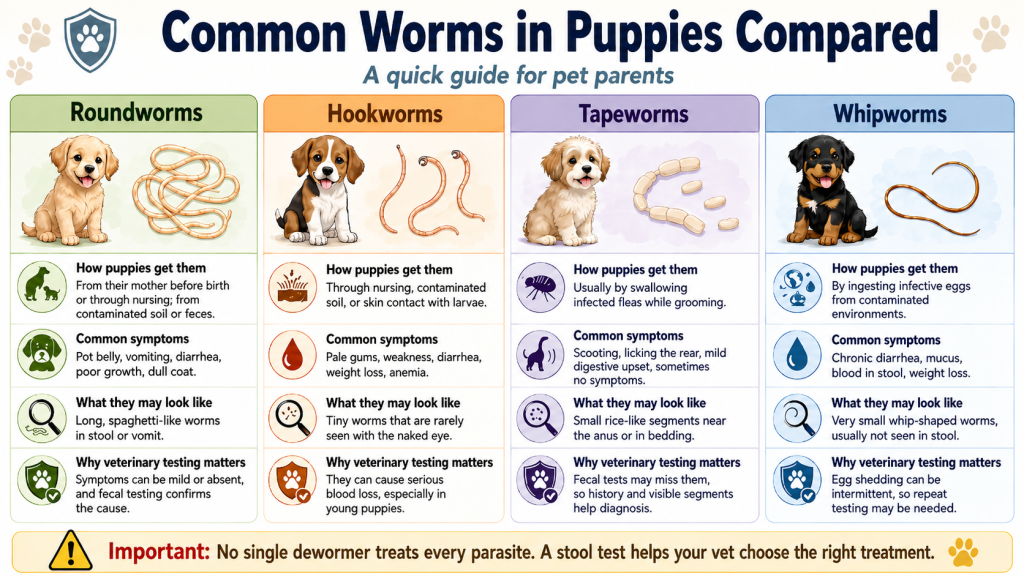
Roundworms
Roundworms are common in young dogs. They may cause a potbelly, poor growth, vomiting, diarrhea, or a dull coat. However, some infected puppies show no outward signs.
Hookworms
Hookworms consume blood after attaching to the intestinal lining. Heavy infections may cause pale gums, weakness, dark stool, poor growth, and dangerous anemia.
Tapeworms
The common flea tapeworm spreads when a puppy swallows an infected flea while grooming. Owners often notice moving or dried segments that resemble grains of rice around the dog’s rear or bedding.
Whipworms
Whipworms live in the large intestine and may cause chronic diarrhea, mucus, fresh blood, or weight loss. Their eggs can be difficult to detect during the early stage of an infection.
How Veterinarians Diagnose Intestinal Parasites
Your veterinarian will ask about symptoms, past treatments, flea exposure, and your puppy’s background. A fresh stool sample may be checked under a microscope or tested for parasite antigens or DNA.
One negative sample does not always close the case. Egg shedding may be intermittent, and tapeworms are not reliably found through routine fecal flotation.
Your vet may repeat testing or investigate Giardia and coccidia if diarrhea continues. These organisms are not worms, so an ordinary puppy worm medicine may not treat them.
A Typical Puppy Deworming Schedule
CAPC recommends beginning routine roundworm treatment at approximately two weeks of age. Treatment is generally repeated every two weeks until puppies are four to eight weeks old, followed by an effective monthly parasite-control product.
Your veterinarian may adjust this puppy deworming schedule based on local parasite risks, the puppy’s living conditions, previous treatment, and fecal-test results.
The schedule often lines up with vaccination visits. Bring a stool sample and a list of products already given.
Rescue puppies and dogs from crowded housing may need extra testing rather than random medication. Giving more dewormer is not necessarily better when you do not know which parasite you are treating.

How Puppy Dewormers Work
Common active ingredients include pyrantel pamoate, fenbendazole, praziquantel, and febantel. They disrupt parasites in different ways.
Pyrantel, for example, appears in products aimed at certain roundworms and hookworms. Praziquantel is commonly included for tapeworm coverage, while fenbendazole may target several intestinal worms.
That is why two boxes can both say “dewormer” while treating different worms. Repeat treatment may also be necessary because a medicine can remove intestinal adults without eliminating immature stages migrating through the body.
How to Choose the Right Puppy Dewormer
Start with four questions:
- Which parasite is suspected or confirmed?
- Is the product labeled for your puppy’s age?
- Does your puppy fall within the listed weight range?
- Has your puppy received another parasite medicine recently?
Read the active ingredients, not just the front-label promise. A product advertising “seven-way protection” may still be unsuitable for a very young puppy or a puppy outside its stated weight range.
Avoid livestock formulations, human products, and improvised dosing charts. Concentrations vary, and a decimal-point mistake can become an emergency.
When you are unsure, show the packaging to your veterinarian before administering it.
How to Give Dewormer Safely
Weigh your puppy as accurately as possible and follow the veterinarian’s instructions or product label exactly. Use the supplied syringe, packet, or measuring device when one is provided.
Never estimate a liquid dose using a household spoon or bottle cap.
For liquids, shake the bottle if directed and measure carefully. Mix granules into a small portion of food your puppy will finish before serving the rest of the meal.
With chewables, watch until the tablet is swallowed rather than hidden behind the sofa like medicinal treasure.
Write down the product name, active ingredients, amount given, and date. This small habit becomes extremely useful if another family member handles the next dose or your veterinarian needs to review the treatment.
What to Expect After Treatment
Many puppies act normally after receiving a puppy dewormer. Mild digestive upset can occur, and you may see worms or fragments in stool—or nothing at all.
Not seeing worms does not mean the medicine failed. Some parasites break down inside the digestive tract, while others are too small to notice.
Call your veterinarian for ongoing vomiting, severe diarrhea, weakness, facial swelling, breathing changes, or a suspected overdose.
Complete recommended repeat doses and follow-up tests. Feeling better does not prove that every parasite stage has gone.
How to Prevent Worms From Coming Back
Medication handles the current infection. Daily habits lower the chance of an unwanted encore.
- Pick up stool promptly at home and in public.
- Wash your hands after handling waste, soil, or outdoor toys.
- Keep flea prevention current.
- Prevent scavenging, hunting, and stool eating.
- Wash bedding and clean contaminated surfaces.
- Schedule routine fecal testing.
- Keep children away from areas contaminated with pet feces.
Some canine roundworms and hookworms can also affect people. Prompt waste removal, good hand hygiene, and regular veterinary care therefore protect the whole household—not just the puppy.
If another dog is joining the household, arrange veterinary checks and introduce the pets gradually. This guide to the best way to introduce your dog to a new puppy can help you manage their first meetings with less stress and better supervision.
Five Amazon Puppy Dewormer Products to Discuss With Your Vet
The following products target different worms and use different active ingredients. Inclusion is not a medical endorsement.
Confirm the diagnosis, age and weight limits, dose, and compatibility with other medicines before treating your puppy.
1. Nemex-2 Wormer 2 oz
Nemex-2 is a liquid pyrantel pamoate product intended to control large roundworms and hookworms in dogs. It is marketed for use in puppies and adult dogs.
Features: Palatable liquid formula, measured dosing, and roundworm and hookworm coverage.
Best for: Owners who need a puppy-labeled liquid after a veterinarian confirms that pyrantel is appropriate.
2. Safe-Guard Canine Dewormer for Small Dogs, 3-Day Treatment
Safe-Guard contains fenbendazole and comes in granules that can be mixed with food. The treatment is given over three consecutive days according to the package directions.
Features: Weight-based packets, three-day treatment format, and coverage for several common intestinal worms.
Best for: Puppies at least six weeks old when a veterinarian recommends fenbendazole and confirms the correct packet size.
3. PetArmor 7 Way De-Wormer for Small Dogs and Puppies
This flavored chewable combines pyrantel pamoate and praziquantel. It targets several species of roundworms, hookworms, and tapeworms.
Features: Broad-spectrum chewable, small-dog formula, two active ingredients, and dosing for dogs weighing 6 to 25 pounds.
Best for: Puppies that meet the product’s current age and weight requirements when tapeworm coverage is also needed.
4. Worm X Plus 7 Way De-Wormer for Small Dogs and Puppies
Worm X Plus is another chewable containing pyrantel pamoate and praziquantel. Its small-dog version is intended for dogs weighing between 6 and 25 pounds.
Features: Flavored tablets, weight-based directions, and coverage for certain roundworms, hookworms, and tapeworms.
Best for: Small dogs or eligible puppies after checking the current package label and speaking with a veterinarian.
5. Durvet 12-Pack Triple Wormer Tablets for Puppies and Small Dogs
Durvet Triple Wormer is a chewable broad-spectrum product containing pyrantel pamoate and praziquantel. The package is designed for puppies and small dogs.
Features: Chewable format, multi-tablet pack, weight-based use, and coverage aimed at common tapeworms, roundworms, and hookworms.
Best for: Eligible puppies and multi-dog households following a veterinarian-approved parasite-control plan.
What Research Says About Parasites in Young Dogs
A 2022 study examined 386 fecal samples collected from dogs during their first year of life. Researchers detected Giardia in 29% of samples and mixed infections in 10.6%. A dog’s origin and living environment also influenced its infection risk.
This study of gastrointestinal parasites in young dogs shows why symptoms may involve more than one organism and why a standard wormer may not solve every case.
CAPC’s expert puppy roundworm deworming guidance recommends beginning treatment early and transitioning puppies to ongoing monthly parasite control.
That guidance supports a planned prevention program rather than waiting until you see a worm wriggle across the floor—an image nobody needs before breakfast.
Puppy Dewormer FAQs
Can I deworm my puppy without seeing a veterinarian?
Some dewormers are sold over the counter, but a veterinary visit is still wise. A stool test can identify the likely parasite, reveal Giardia or coccidia, and help prevent incorrect dosing or unnecessary treatment.
How quickly does puppy dewormer work?
Some medicines begin affecting worms within hours, but visible improvement and parasite clearance vary. Repeat treatment or follow-up testing may be necessary because products do not always kill every parasite or life stage.
Is diarrhea normal after deworming a puppy?
Mild, brief stool changes can occur. Persistent diarrhea, blood in the stool, repeated vomiting, weakness, or poor drinking requires veterinary advice, especially in a very young puppy.
Can humans catch worms from puppies?
Certain roundworms and hookworms can affect people. Prompt stool cleanup, handwashing, footwear outdoors, routine veterinary care, and keeping play areas free of pet waste help reduce the risk.
Why Does My Puppy Still Have Worms After Treatment?
The product may not cover that worm, the dose may have been incorrect, immature stages may have matured later, or reinfection may have occurred.
Your veterinarian may repeat the stool test and select a different treatment. Do not immediately repeat the dose unless the label or veterinarian specifically tells you to do so.
Final Thoughts on Puppy Deworming
A good puppy dewormer matters, but the best results come from pairing medication with testing, accurate weight-based use, sanitation, flea control, and follow-up.
Watch for changes in your puppy’s appetite, stool, energy, and growth. You know their usual rhythm better than anyone, so those small observations can provide valuable clues.
With a thoughtful plan and veterinary support, parasite worries become a manageable puppy-care task—leaving more time for teaching “sit” and negotiating the return of your missing sock.