5 Effective Ways To Handle Separation Anxiety In Dogs

We may earn a commission for purchases made using our links. Please see our disclosure for more details.
If you’ve ever grabbed your keys and immediately felt your stomach drop—because you know your dog is about to spiral—yeah. That’s exhausting. And it can make you feel guilty in a very specific way… like you’re doing something wrong just by having a life. Separation Anxiety In Dogs is real, common, and more treatable than most people think. One large study notes separation anxiety shows up in roughly 14–20% of dogs. So if this is happening in your home, you’re not “failing.” You’re in a very normal, very fixable situation.
In this guide, I’ll walk you through 5 effective ways to handle it—plus practical training steps, what not to do, and when it’s time to bring in a pro.
Affiliate disclaimer: This article contains a short Amazon product section (no extra cost to you if you choose to buy).
Separation Anxiety In Dogs: The Signs You’ll Notice at Home
Separation anxiety doesn’t always look like dramatic howling and shredded couches (although… it can). Sometimes it’s subtle.
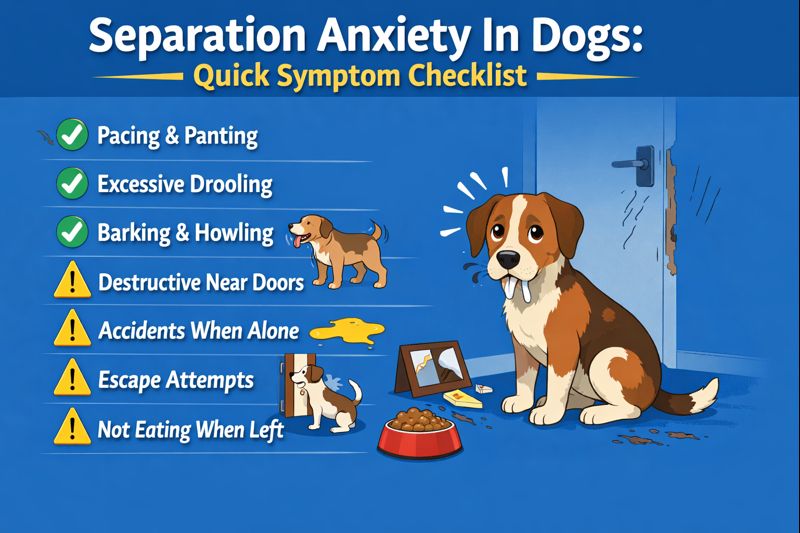
Common dog separation anxiety symptoms
- Following you room-to-room like a tiny fuzzy shadow
- Panting, pacing, drooling when you prepare to leave
- Barking/howling shortly after the door closes
- Scratching at doors/windows, chewing frames
- Peeing/pooping only when alone (even if potty-trained)
- Refusing food or ignoring toys when you’re gone
A quick “does this fit?” check
If your dog is mostly calm when you’re home, but panics specifically during absence, Separation Anxiety In Dogs jumps to the top of the list.
Why do dogs get separation anxiety?
Right here, at its core, separation anxiety is fear, not protest.
Dogs can learn, “When my person leaves, something bad happens,” even if nothing actually bad happens. Their nervous system doesn’t care about logic—it cares about patterns.
Common triggers
- A sudden schedule change (new job hours, school, travel)
- Moving homes (even “better” homes!)
- New family setup (breakup, baby, roommate, loss)
- A history of rehoming or shelter time
- Under-socialization to being alone (hello, post-WFH era)
And yes—some dogs are just more sensitive. That’s not weakness. It’s wiring.
Anxiety about being apart or something else?
Before you commit to a separation anxiety training plan, make sure you’re not chasing the wrong problem.
Boredom looks like…
- Chewing random stuff even when you’re home
- “Mischief” that happens after long under-stimulated days
- A dog who will happily eat/chew when left alone
Separation anxiety looks like…
- Distress tied to your absence
- Inability to settle, eat, or engage when alone
- Escalation: pacing → vocalizing → destruction → self-injury risk
A helpful rule: boredom is “I need something to do.” Anxiety is “I can’t cope.”
Step One: Rule Out Medical Issues and Routine Problems
I know this part is unglamorous, but it matters.
- Sudden house soiling can involve GI issues, urinary issues, or pain.
- Older dogs might have cognitive decline, hearing loss, or new sensitivities.
- Puppies might just need more potty structure.
Also: double-check basics (food, water, temperature, potty breaks). When your dog feels physically secure, training works faster.
Way 1: Build a Predictable “I’m Leaving” Routine
Your goal is to make leaving feel boring and safe—like brushing your teeth, not like an emotional earthquake.
Try this calm departure script
- 10 minutes before leaving: reduce excitement (no hyping up)
- Give a potty break
- Offer a simple enrichment item (more on this soon)
- Say a short, consistent phrase: “Back soon.”
- Leave
Keep it simple. Your dog learns patterns. You’re building a good one.
Way 2: Desensitize the “Leaving Cues” (Keys, Shoes, Bags)
Some dogs start panicking before you even step outside. That’s because they’ve memorized your pre-leave routine like a detective.
The “fake leave” game (tiny reps)
Do 5–10 reps a day:
- Pick up keys → put them down → sit back on the couch
- Put on shoes → walk to the door → walk back
- Grab bag → open door → close door → make coffee like nothing happened
You’re teaching: keys don’t predict abandonment.
This is desensitization and counterconditioning in plain clothes.
Way 3: Teach Alone-Time Like a Skill (Small Wins Only)
This is the core of separation anxiety training: exposure that stays under panic level.
Think of it like learning to swim. You don’t start by tossing someone into the deep end. You start with toes in the water.
A simple ladder you can use
- Step out of sight for 1–3 seconds
- Return before distress
- Repeat until boring
- Increase to 10 seconds → 30 seconds → 1 minute → 3 minutes
- Slowly build up
Two rules that keep this working
- Return while your dog is still okay (that’s the win)
- If your dog panics, you went too fast—drop back down
If you only remember one thing: panic is not practice. Calm is practice.
Way 4: Create a Safe Space Your Dog Actually Likes
Some dogs relax in a crate. Others hate it. The “right” safe space is the one your dog chooses—or learns to love gently.
Options that can work
- A cozy crate with the door open (crate training for anxiety is gradual)
- A puppy-proof room (bedroom, laundry area, office)
- A gated corner of the house with a bed + water
Add:
- soft bedding (unless your dog shreds it)
- white noise
- a shirt that smells like you
And here’s a small thing people overlook: make “home base” comfortable for everyday routines too—like meals. If you’re adjusting your dog’s setup, a stable feeding station can help some dogs feel more grounded. You can check dog food bowls that support comfortable daily routines for ideas that fit different sizes and eating styles.
Way 5: Use Enrichment to Make Alone-Time Feel Worth It
This is not “distract them and hope.” This is: teach their brain to settle.
Best dog enrichment ideas for separation anxiety
- Stuffed food toys (frozen for longer)
- Licking mats (licking lowers arousal for many dogs)
- Sniffing games (snuffle mats, scatter feeding)
- Long-lasting chews (safe, size-appropriate)
Pro tip: Save “special” enrichment for alone-time. You want your dog thinking, “Ohhh, THIS moment. This is when the good stuff appears.”
A Simple “Calm Alone” Menu You Can Rotate
If you’ve ever stood in your kitchen thinking, “What do I even give them?”—same.
Try rotating:
- Frozen stuffed toy (10–30 min)
- Lick mat (5–20 min)
- Sniff scatter in a towel or cardboard box (supervised setup first)
- Short training session before you leave (2–4 minutes)
The point isn’t perfection. The point is consistency.
What Not To Do: Mistakes That Quietly Make Anxiety Worse
No shame here—most people do these because they care.
Avoid these common traps
- Big emotional goodbyes (it raises the “this is scary” signal)
- Punishment for accidents/destruction (your dog panicked; punishment adds fear)
- Pushing “cry it out” for true separation anxiety (can worsen distress)
- Leaving too long too soon during training
A helpful reframe: you’re not “correcting behavior.” You’re teaching safety.
A 2-Week Starter Plan You Can Repeat
This is a starter structure—not a magic stopwatch. Some dogs move faster, some slower.
Days 1–3: Lower the alarm
- Fake leaving cues 5–10 reps/day
- Safe space setup + enrichment practice while you’re home
- 1–10 second out-of-sight reps (multiple mini sessions)
Days 4–7: Build tiny duration
- 10–60 seconds reps
- Mix in door-open/door-close practice
- Keep returns calm and neutral
Days 8–14: Add real-life realism
- Short real departures (trash out, mailbox) only if your dog stays calm
- If your dog struggles, return to the last “easy” step
If you want a measurement that actually helps: track the longest calm time (not the longest time they screamed).
Special Situations: Puppies, Rescues, and Multi-Dog Homes
If you have a new rescue
Go slower than you think you need. New environments can amplify stress. You’re building trust, not just tolerance.
If you have two dogs
Sometimes one dog’s panic sets off the other. Try separate safe spaces, separate enrichment, and separate training reps (even if it feels extra).
If you’re in a small apartment
You can still do this. White noise + quiet enrichment + a consistent alone-time ladder can reduce neighbor-stress fast. The training is about the dog’s nervous system, not your square footage.
When to Get Professional Help
If your dog shows any of these, bring in help sooner rather than later:
- self-injury risk (bloody paws, broken teeth, chewing doors)
- nonstop panic that doesn’t improve with basic steps
- aggression when you prepare to leave
- severe noise sensitivity + separation distress combined
Who to look for
- A trainer experienced in separation anxiety training (ask what method they use)
- A veterinary behaviorist or vet with behavior focus
- A plan that includes gradual desensitization and counterconditioning (not punishment)
And yes—sometimes medication supports learning. Which brings us to the science.
5 Helpful Products for Separation Anxiety In Dogs
These are popular, low-regret tools that support training (not replace it). I’m listing them with the Amazon rating/review ballpark so you can filter quickly.
ThunderShirt for Dogs, Heather Gray Classic (Calming Vest)
- Why it helps: gentle, even pressure can reduce arousal for some dogs
- Key features: snug wrap design, easy on/off, size range
- Best for: dogs who start spiraling before you leave
Amazon Basics Foldable Metal Wire Dog Crate
- Why it helps: creates a consistent “den” space (only if crate is introduced gently)
- Key features: foldable, multiple sizes, removable tray
- Best for: dogs who settle in enclosed spaces; structured alone-time training
KONG Classic Stuffable Dog Toy
- Why it helps: licking/chewing + problem-solving = calmer brain
- Key features: durable rubber, stuffable, size options
- Best for: dogs who need a “job” when you leave
LickiMat (Lick Mat for Dogs)
- Why it helps: licking is soothing for many dogs and extends snack time
- Key features: textured surface, can freeze, works with wet foods
- Best for: mild-to-moderate anxiety, pre-departure calming routine
Purina Pro Plan Veterinary Supplements Calming Care
- Why it helps: some dogs benefit from nutritional calming support alongside training
- Key features: daily supplement format, easy to add to food
- Best for: dogs with generalized stress + separation distress
What the Research and Vets Say About Separation Anxiety In Dogs
Two big takeaways show up again and again: behavior work is the foundation, and in tougher cases, meds can help dogs learn.
1) Behavior modification is the “main dish,” not a side salad
A peer-reviewed review on Separation Anxiety In Dogs emphasizes that the most successful approach typically centers on systematic desensitization and counterconditioning, sometimes supported by medication early on. It also notes separation-related behavior
2) Medication can improve outcomes when paired with training
A randomized controlled trial found fluoxetine (Reconcile) plus behavior management showed clinical efficacy and safety for canine separation anxiety (Simpson et al., 2007). In plain English: meds don’t “fix” the dog—they lower panic enough for learning to happen.
(And for another medication example: clomipramine has also been studied in a randomized, placebo-controlled trial alongside behavioral therapy.)
FAQs About Separation Anxiety In Dogs
How long does it take for dogs to get over separate anxiety?
Most dogs improve in weeks to months, depending on severity and consistency. Progress isn’t linear—think “trend line,” not “every day is better.”
Can I put a dog in a crate that has severe separation anxiety?
Sometimes yes, sometimes no. If the crate reduces stress, great. If your dog panics harder in confinement, don’t force it—use a larger safe space and train gradually.
Will getting a second dog cure Separation Anxiety In Dogs?
Not reliably. Some dogs do better with company, but research suggests another dog doesn’t automatically prevent separation-related problems.
Do chews that calm dogs down help with separation anxiety?
They can help mild cases or “take the edge off,” but they won’t replace training. Use them as support, not the whole plan.
What’s the fastest way to reduce Separation Anxiety In Dogs barking?
Short-term: white noise + enrichment + shorter absences. Long-term: desensitization to leaving + alone-time ladder training (return before panic).
Conclusion
If your dog struggles with Separation Anxiety In Dogs, you’re not dealing with stubbornness—you’re dealing with fear. And fear responds best to patience, structure, and tiny wins stacked on purpose.
Start small. Celebrate calm seconds like they’re milestones (because they are). And if you need help—trainer, vet, behaviorist—that’s not “giving up.” That’s being the kind of dog parent who chooses support over suffering.